
egyptian arabic vs MSA Estimated reading time: 8 minutes | Word count: 1,450+
Introduction
You’ve finally decided to learn Arabic. Congratulations! It’s a beautiful, rich language spoken by over 400 million people across more than 20 countries. But almost immediately, you hit your first major roadblock: Which Arabic should you learn?
If you’ve done any research, you’ve probably encountered two terms: Modern Standard Arabic (MSA) and Egyptian Arabic (Egyptian Colloquial). Maybe you’ve heard conflicting advice:
- “Learn MSA first—it’s the formal language everyone understands.”
- “No, start with Egyptian Arabic—it’s what people actually speak!”
Both statements are true. And that’s exactly what makes this decision so confusing for beginners.
I’ve spent years teaching Arabic to non-native speakers at Alphabet Arabic Academy, and I’ve watched hundreds of students struggle with this exact question. Some chose MSA, moved to an Arab country, and couldn’t understand a word on the street. Others learned a dialect, then realized they couldn’t read a newspaper or understand formal media.
The truth is: there’s no single “right” answer—but there IS a right answer for your specific goals.
In this comprehensive guide, I’ll walk you through everything you need to know to make that decision with confidence. By the end, you’ll know exactly which path to take—and whether learning both might actually be your best option.
What Is Modern Standard Arabic (MSA)?
Let’s start with the formal side of the coin.
Modern Standard Arabic (MSA), known in Arabic as al-Fuṣḥā (الفصحى), is the standardized, literary Arabic used across the Arab world for formal purposes. It’s the direct descendant of Classical Arabic—the language of the Quran, pre-Islamic poetry, and over a thousand years of Islamic scholarship.
Where You’ll Find MSA
- News media: Al Jazeera, BBC Arabic, Al Arabiya—every news broadcast is in MSA
- Newspapers and books: Every published newspaper, novel, and academic text
- Official documents: Government papers, legal contracts, passports
- Speeches: Presidential addresses, UN speeches, formal lectures
- Religious texts: The Quran, Hadith collections, Islamic scholarship
- Education: Taught in schools across the Arab world as the formal language
The Advantages of Learning MSA First
1. Universally understood
An MSA speaker can communicate with educated Arabs from Morocco to Iraq. A Moroccan who speaks only Darija (Moroccan dialect) might struggle with an Egyptian, but both will understand MSA.
2. Gateway to written Arabic
If you want to read newspapers, books, or religious texts, MSA is non-negotiable. It’s the language of the written word across the entire Arab world.
3. Foundation for learning dialects
Once you know MSA, picking up any dialect becomes significantly easier. You’ll understand the “skeleton” of the language—dialects are essentially MSA with simplified grammar, different pronunciation, and local vocabulary.
4. Professional and academic opportunities
For careers in diplomacy, journalism, academia, or international business involving the Middle East, MSA is often required. It’s the language of formal communication.
The Disadvantages of Learning Only MSA
1. No one speaks it naturally
Here’s the hard truth: no Arab grows up speaking MSA at home. Children learn their local dialect from their parents. MSA is learned in school, like formal English is learned by native English speakers.
If you spend years mastering MSA and arrive in Cairo, here’s what will happen:
You (in perfect MSA): “Excuse me, where is the nearest restaurant?” (Hal yumkinuka an tadulla ‘ala aqrab mat’am?)
Egyptian taxi driver: [Blank stare] “…What?”
You: [Confused] “I learned Arabic for two years…”
The taxi driver understands MSA—but it sounds to him like Shakespearean English coming out of a foreigner’s mouth. It’s formal, stiff, and unexpected.
2. Missing cultural connection
Dialects carry the soul of a culture. Jokes, songs, movies, and everyday expressions live in dialects. You can watch an Egyptian film in MSA translation, but you’ll miss the humor, the slang, the feel of how people actually talk.
3. Slower conversational progress
MSA grammar is complex. You’ll spend months mastering cases and verb forms before you can hold even a basic conversation. Meanwhile, dialect learners are speaking from week one.
What Is Egyptian Arabic?

Now let’s look at the other side: Egyptian Arabic, also called Masri (مصرى) or Egyptian Colloquial Arabic.
Egyptian Arabic is the spoken language used by over 100 million Egyptians in their daily lives. It’s the dialect you’ll hear in Cairo’s streets, Egyptian movies, and popular songs across the Arab world.
Why Egyptian Arabic Specifically?
The Arab world has dozens of dialects—Moroccan, Algerian, Tunisian, Libyan, Egyptian, Sudanese, Levantine (Lebanese/Syrian/Jordanian/Palestinian), Gulf (Saudi, Emirati, Kuwaiti), Iraqi, and more. So why focus on Egyptian?
Egyptian Arabic is the most widely understood dialect across the Arab world. Thanks to Egypt’s dominance in film, music, and media throughout the 20th century, virtually every Arab has grown up watching Egyptian movies and listening to Egyptian singers like Umm Kulthum and Abdel Halim Hafez.
A Moroccan might not understand a Saudi dialect speaker—but both will likely understand Egyptian.
Where You’ll Find Egyptian Arabic
- Daily conversation: On the streets of Cairo, Alexandria, and every Egyptian city
- Egyptian cinema: The largest film industry in the Arab world
- Popular music: From classic singers to modern pop stars
- Social media: Egyptian influencers, TikTok, YouTube
- Informal settings: With friends, family, at cafes
The Advantages of Learning Egyptian Arabic First
1. Speak from day one
Egyptian Arabic grammar is simpler than MSA. You drop most case endings, simplify verb conjugations, and focus on what people actually say. Many students have basic conversations within weeks—not months.
2. Real-world communication
When you arrive in Egypt, you’ll actually understand people. You’ll be able to:
- Bargain in Khan el-Khalili market
- Order food like a local (“Koshari, please—extra onions!”)
- Chat with taxi drivers about football
- Make Egyptian friends naturally
3. Cultural access
Egyptian movies, songs, and TV shows open up. You’ll understand the jokes, the slang, the cultural references. You’ll laugh when Egyptians laugh.
4. Widely understood
Travel to Lebanon? Your Egyptian Arabic will be understood. Visit the Gulf? They’ve grown up with Egyptian media. Even in Morocco, where the local dialect is very different, many will understand your Egyptian.
The Disadvantages of Learning Only Egyptian Arabic
1. Limited to spoken contexts
Egyptian Arabic won’t help you read a newspaper, understand formal news broadcasts, or read classical texts. If you need literacy, you’ll eventually need MSA.
2. Not “formal” Arabic
You can’t write a professional email in Egyptian Arabic. You can’t give a formal speech. For professional and academic contexts, MSA is required.
3. Regional limitations
While Egyptian is widely understood, traveling to Morocco or Algeria might still present challenges. The local dialects there are quite different, and not everyone responds comfortably to Egyptian.
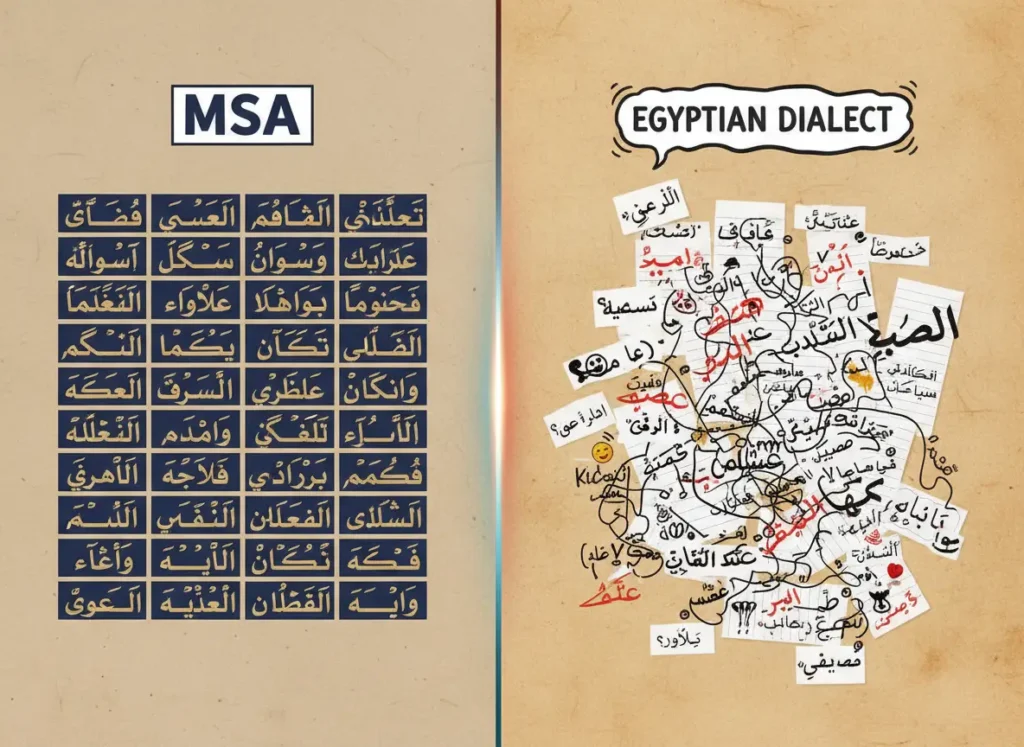
Head-to-Head Comparison: Egyptian Arabic vs MSA
| Aspect | Modern Standard Arabic (MSA) | Egyptian Arabic |
|---|---|---|
| Where it’s used | Formal media, writing, speeches, education | Daily conversation, movies, songs, informal settings |
| Native speakers | None (second language for all Arabs) | ~100 million native speakers |
| Grammar complexity | Complex (full case system, moods) | Simplified (dropped cases, simpler verbs) |
| Time to basic conversation | 6–12 months | 4–8 weeks |
| Literacy | Essential for reading/writing | Not used for writing |
| Geographic range | Understood by all educated Arabs | Widely understood across Arab world |
| Cultural access | Formal culture (news, literature) | Popular culture (movies, songs, slang) |
| Best for | Academics, professionals, religious study | Travelers, expats, social connection |
How to Decide: A Decision Framework

Still unsure? Let me walk you through a simple decision tree based on your goals.
Choose MSA First If:
1. Your primary goal is reading the Quran or Islamic texts
If your main motivation is religious—understanding the Quran, studying Hadith, reading Islamic scholarship—start with MSA. The Quran is in Classical Arabic, which is very close to MSA. Dialects won’t help you here.
2. You need Arabic for academic or professional purposes
Journalists covering the Middle East, diplomats, academics, researchers—you need MSA. Your work will involve reading newspapers, analyzing formal speeches, and possibly writing professionally.
3. You want to be able to read and write
If literacy is important to you from the beginning, MSA is the path. You’ll learn the alphabet, reading, and writing systematically.
4. You plan to travel across multiple Arab countries
An MSA speaker can be understood (in formal contexts) everywhere. You’ll be able to read signs, menus, and official documents across the entire Arab world.
Choose Egyptian Arabic First If:
1. You’re moving to Egypt or marrying an Egyptian
If you’ll be living in Egypt or integrating into an Egyptian family, learn Egyptian Arabic. Your daily life—talking to in-laws, shopping, making friends—will be in dialect. MSA won’t help you connect with your new family.
2. You want to speak quickly
If your goal is conversational fluency as fast as possible, Egyptian Arabic is the shortcut. You’ll be speaking within weeks, building confidence and momentum.
3. You love Egyptian culture—movies, music, history
Want to understand Youssef Chahine films? Sing along to Amr Diab? Get the jokes in Egyptian comedy sketches? Learn Egyptian Arabic.
4. You plan to live in Egypt long-term
Expats, aid workers, diplomats stationed in Cairo—your daily life will be in Egyptian. Learn the dialect.
The Honest Truth: Most Serious Learners End Up Learning Both
Here’s what I tell my students at Alphabet Arabic Academy: the question isn’t really “which one?”—it’s “which one first?”
Most dedicated Arabic learners eventually learn both:
- MSA for literacy, formal contexts, and deep understanding
- A dialect (often Egyptian) for real communication and cultural connection
The order depends on your priorities. But the journey usually includes both destinations.
Practical Paths: Three Ways to Approach This
Path 1: MSA First, Then Egyptian
Best for: Academics, religious students, those wanting deep literacy first
- Months 1–6: Master the alphabet, basic reading/writing, fundamental MSA grammar
- Months 7–12: Build MSA vocabulary, start reading simple texts, practice formal speaking
- Year 2: Begin dialect exposure while continuing MSA—watch Egyptian movies, learn common phrases
- Year 3: Switch to dialect-focused practice while maintaining MSA for reading
Path 2: Egyptian First, Then MSA
Best for: Expats, those married to Egyptians, fast conversationalists
- Months 1–3: Learn to speak Egyptian Arabic—greetings, daily conversations, essential phrases (using transliteration if needed)
- Months 4–6: Expand vocabulary, start understanding movies, build conversational confidence
- Month 7+: Begin alphabet and reading skills while maintaining spoken Egyptian
- Year 2: Add MSA grammar and formal vocabulary systematically
Path 3: Integrated Learning
Best for: Flexible learners with good language aptitude
- Months 1–6: Learn MSA alphabet and basic grammar while simultaneously picking up common Egyptian phrases
- Ongoing: Treat MSA as your “formal register” and Egyptian as your “informal register”
- Progress: Read in MSA, speak in Egyptian—your brain will learn to switch contexts
At Alphabet Arabic Academy, we offer both tracks and can design a custom path based on your goals. Our native Egyptian teachers are trained to teach both MSA and dialect, and we’ll help you navigate this decision during your free trial lesson.
What About Learning Arabic Script?
A common question: “Do I need to learn the Arabic script to learn Egyptian Arabic?”
The honest answer: Not necessarily—but you probably should.
You can learn Egyptian Arabic using transliteration (writing Arabic words with English letters). Many students do this and become fluent speakers without ever reading the script. It’s possible.
But here’s why learning the script is worth it:
- You’ll learn MSA eventually (if you’re serious about Arabic), and the script is required
- Street signs, menus, and written materials become accessible
- Your pronunciation improves when you see the actual letters
- You connect more deeply with the language’s written tradition
At minimum, I recommend learning to read the alphabet—it takes 2-3 weeks of practice and opens up a new world. Writing is optional if your only goal is speaking.
Common Myths About Arabic Dialects vs MSA

Myth 1: “MSA is artificial—no one really speaks it.”
Truth: MSA is learned, not acquired naturally, but educated Arabs do use it in formal contexts. It’s like “BBC English”—not how people chat with friends, but very real in its domain.
Myth 2: “If you learn Egyptian, you’ll understand all Arabs.”
Truth: You’ll understand many Arabs, especially in the Levant and Gulf, but not all. Moroccan and Algerian dialects are quite different and may still be challenging.
Myth 3: “Learning dialect first will ruin your MSA later.”
Truth: This is a common fear, but I’ve seen hundreds of students learn dialect first and successfully add MSA later. Your brain can distinguish contexts. It’s like learning informal English before formal English—both are useful in different situations.
Myth 4: “You have to choose one—you can’t learn both.”
Truth: Most serious Arabic learners do learn both. The question is just which one you start with. At Alphabet Arabic Academy, many students eventually take both tracks.
Real Student Stories
Sarah’s Story: MSA First
Sarah came to us as a graduate student in Middle Eastern studies. She needed to read academic texts and analyze news media. We started her on MSA.
For six months, she focused on reading, grammar, and formal vocabulary. By month seven, she could read newspaper articles with a dictionary. By year one, she was analyzing political speeches.
But when she traveled to Cairo for research, she hit a wall. “I couldn’t understand anyone on the street,” she told me. “My Arabic was perfect—and completely useless for daily life.”
Sarah added Egyptian Arabic in her second year. Within three months, she was chatting with taxi drivers and bargaining in markets. Today, she uses MSA for her research and Egyptian for fieldwork. Both were essential.
Michael’s Story: Egyptian First
Michael was engaged to an Egyptian woman and moving to Cairo. “I need to talk to my future in-laws,” he said. “I don’t care about reading newspapers yet.”
We started him on Egyptian Arabic, using transliteration at first. Within weeks, he was greeting his fiancée’s family in Egyptian. Within six months, he was holding conversations at family dinners.
After a year in Cairo, Michael came back to us. “Now I want to read,” he said. “I want to understand the Quran, read signs, and surprise my wife by reading Arabic.” We added MSA literacy to his repertoire, and within months he was reading children’s books and eventually Quranic verses.
Michael’s path was reversed from Sarah’s—but both reached the same destination: fluency in both registers.
How Alphabet Arabic Academy Can Help
At Alphabet Arabic Academy, we specialize in teaching both Modern Standard Arabic and Egyptian Colloquial to non-native speakers. Our native Egyptian teachers are trained to help you navigate exactly this decision.
We Offer:
- MSA Track: Comprehensive curriculum from alphabet to advanced grammar
- Egyptian Arabic Track: Conversation-focused program designed to get you speaking quickly
- Integrated Programs: Custom paths that combine both based on your goals
- Free Trial Lesson: Meet a teacher, discuss your goals, and experience our method
Your Decision Checklist
Before you decide, ask yourself these questions:
- Why am I learning Arabic? (Religious, professional, travel, family?)
- Where will I primarily use Arabic? (In which countries? Formal or informal settings?)
- Do I need to read and write, or just speak?
- How quickly do I want to have conversations?
- Will I eventually want both? (Most serious learners do.)
Final Recommendation
If you’re still uncertain after reading this guide, here’s my simplest advice:
- If your main goal involves the Quran, formal study, or professional writing → start with MSA.
- If your main goal involves talking to people, living in an Arab country, or connecting with culture → start with Egyptian Arabic.
- If you’re truly unsure and just want to start learning → take our free trial lesson. Talk to a real teacher. Tell them about your goals. Let them help you decide.
At Alphabet Arabic Academy, we’ve guided thousands of students through this decision. We don’t believe in a one-size-fits-all answer—we believe in finding the right path for you.
Ready to Begin Your Arabic Journey?
Whichever path you choose, the most important step is simply to begin.
Your first conversation in Arabic—whether it’s a formal greeting in MSA or a casual “ezayyak?” in Egyptian—will be a moment you never forget. And with the right guidance, that moment is closer than you think.
👉 Book your free 60-minute trial lesson at Alphabet Arabic Academy today. Meet a native Egyptian teacher, discuss your goals, and take the first step toward speaking Arabic with confidence.
📚 Related Articles:
- Complete Guide to Egyptian Arabic
- Modern Standard Arabic: From Zero to Fluency
- How Long Does It Take to Learn Arabic?
Why should I start learning Modern Standard Arabic (MSA)?
You should start learning MSA if your main goals involve reading the Quran, engaging in academic or professional work, or gaining literacy skills that are useful across the Arab world.
What are the main advantages of learning Egyptian Arabic?
Learning Egyptian Arabic allows for quick conversational fluency, practical communication in daily situations, cultural access through movies and music, and understanding across many Arab countries due to Egypt’s media influence.
Is it better to learn both MSA and Egyptian Arabic?
Most serious learners eventually learn both to achieve literacy and formal understanding with MSA, and cultural and conversational fluency with a dialect like Egyptian Arabic, which offers practical communication skills.
Should I learn the Arabic script when starting?
While not strictly necessary at first, learning the Arabic script is highly recommended because it improves pronunciation, enables reading street signs and written materials, and connects you more deeply with the language’s tradition.
How can I decide whether to learn MSA or Egyptian Arabic first?
Decide based on your goals: choose MSA if you want reading, writing, and formal understanding, especially for religious or academic purposes; choose Egyptian Arabic if your focus is daily conversation, cultural connection, or living in Egypt.